


 Latest:

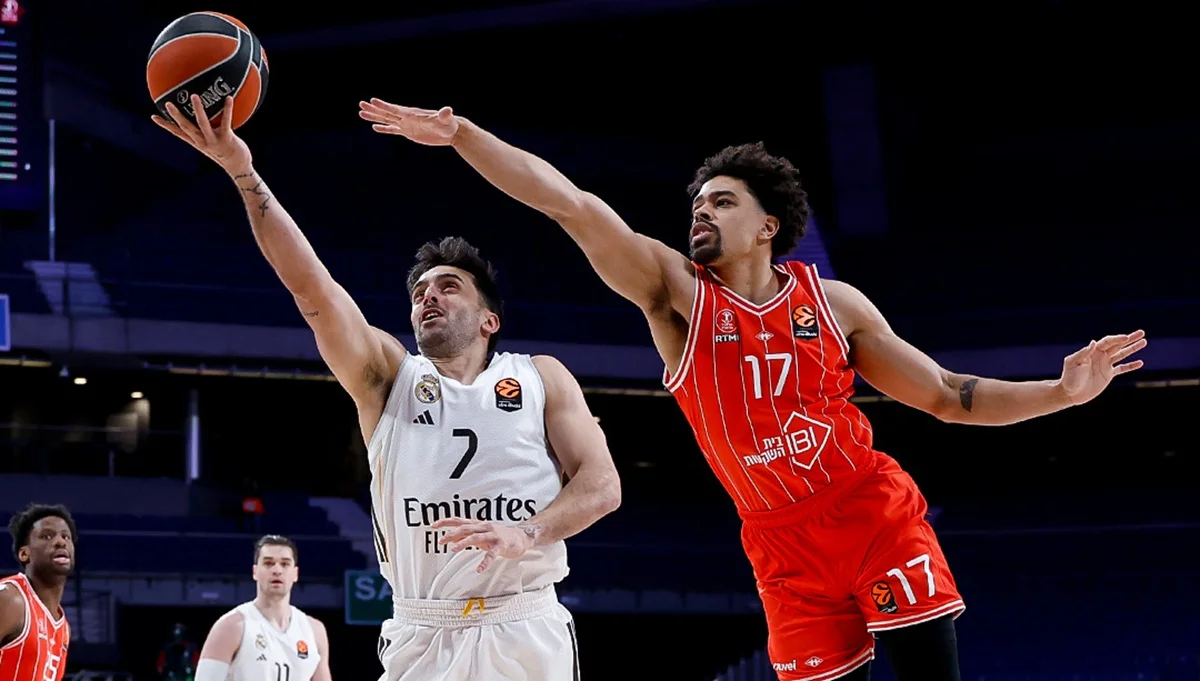
EuroLeague Playoffs Preview: Real Madrid and Hapoel Tel Aviv Set for High-Voltage Quarterfinal Series at Movistar Arena
 abr 25 2026
Real Madrid opens the EuroLeague quarterfinals against Hapoel Tel Aviv in a matchup that promises physicality, pace, and offensive firepower. The third-seeded Madrid hosts the sixth-seeded Israeli squad at Movistar Arena on Wednesday, April 29 at 20:45 CET, with home-court advantage and the challenge of confirming their superiority in a series that could prove far more demanding than the regular season standings suggest.
Real Madrid finished the regular season with 24 wins and 14 losses, while Hapoel Tel Aviv ended with a 23-15 record. The gap between the two teams was minimal, and so was the scoring difference: 87.9 points per game for Madrid and 88.2 for the Israeli squad. However, Madrid holds a clear advantage in efficiency rating, rebounding, assists, and shot-blocking—categories that could define the series.
Madrid More Complete in Key Metrics
The Madrid squad arrives with a 104.1 efficiency rating, the third-best in the competition, compared to Hapoel's 98.8. They also dominate rebounding decisively: 37.5 boards per game versus Hapoel's 32.9. That difference is especially noticeable on the offensive glass, where Madrid averages 11.8 compared to Hapoel's 8.8.
Another crucial stat is near the basket. Real Madrid leads the EuroLeague in blocks with 3.9 per game, and has Walter Tavares as their primary interior anchor. The Cape Verdean center has posted 9.8 points, 6.8 rebounds, 1.9 blocks, and a 15.8 efficiency rating, making him the team's most impactful player in terms of overall influence.
Hapoel: A Dangerous and Highly Efficient Offense
Hapoel Tel Aviv arrives as no secondary invitee. Their offense actually produces a few tenths more than Madrid's, with 88.2 points per game, and stands out especially for their two-point accuracy, leading the competition with 60.1%. That interior efficiency forces Madrid to protect the paint well and reduce advantages near the basket.
The star of the Israeli team is Elijah Bryant, who arrives as the series' most valued player with a 20.6 efficiency rating. His 15.9 points, 5.3 rebounds, and 3.4 assists reflect his overall weight in the game. He's not just a scorer: he also creates, rebounds, and sustains many important possessions.
Around him, Hapoel has plenty of offensive talent. Dan Oturu contributes 13.4 points, 5.4 rebounds, and 1.3 blocks with a powerful 71.3% on two-pointers. Antonio Blakeney adds 13.2 points, Vasilije Micic runs the offense with 11.4 points and 4.2 assists, and Chris Jones contributes 9.7 points, 4.2 assists, and a notable 42.7% from three-point range.
Campazzo, Tavares, and Madrid's Balance
Real Madrid spreads its scoring much more evenly. Trey Lyles leads the team in scoring with 13.3 points, followed closely by Mario Hezonja with 13.2, and Facundo Campazzo with 11.8 points and 5.1 assists. That offensive variety allows Madrid to find solutions from different profiles and not depend on a single scoring avenue.
Campazzo will be one of the key names in the series. His point-guard duel with Micic and Chris Jones could set the pace of the games. If the Argentine can impose defensive pressure, accelerate when needed, and feed Tavares in favorable situations, Madrid will have much ground gained.
The role of Hezonja, Lyles, Gabriel Deck, Theo Maledon, Alberto Abalde, Andrés Feliz, and Usman Garuba will also be fundamental. The Madrid squad has size, outside shooting, legs to defend, and multiple options to adjust lineups depending on the type of game.
Tactical Keys to the Series
For Real Madrid, the first key will be rebounding. Their superiority in size, physicality, and interior presence must translate into second-chance opportunities and pace control. If they dominate the boards, they can run more, punish from the post, and prevent Hapoel from finding comfortable transitions.
The second key will be paint defense. Hapoel is the competition's best team in two-point percentage, and there are threats like Oturu, Bryant, Motley, and Blakeney attacking advantages. Tavares, Garuba, Deck, Okeke, and Lyles will have plenty of work closing spaces without conceding too many free throws.
Hapoel, for its part, will need to move Madrid around, attack before the Madrid defense sets, and take advantage of their great efficiency near the basket. Turnover control will also be important: they average 12.1 per game, slightly better than Madrid, and any extra possession could weigh heavily in a tight series.
Recent History Favors Real Madrid
The recent head-to-head record smiles on Madrid, who lead 2-0 in the two previous matchups between the teams. That data reinforces Madrid's favorite status, but the series arrives with very narrow margins and a Hapoel capable of competing through scoring, outside talent, and interior efficiency.
In the first meeting, on Matchday 13, Real Madrid won narrowly (74-75), where Jones and Blakeney stood out for the home side with 14 points each, and Hezonja was Madrid's standout with 19 points. In the return, at Movistar Arena on Matchday 33, the result was (92-83), with Jones again as the standout player with 15 points, accompanied by Motley and Bryant, both with 13. For Real Madrid, Hezonja with 15 points and 10 rebounds, and Maledon with 13.
Real Madrid starts with home-court advantage, confirmed that the vast majority of spectators will be able to attend, better overall efficiency rating, more rebounding, and a clearly more solid defense. Hapoel Tel Aviv arrives with a high-level offense, the best two-point percentage in the EuroLeague, and an Elijah Bryant in star mode. A series with a clear favorite, but with enough threats to demand Madrid's best version from Game 1.


