


 Latest:

 jun 01 2026
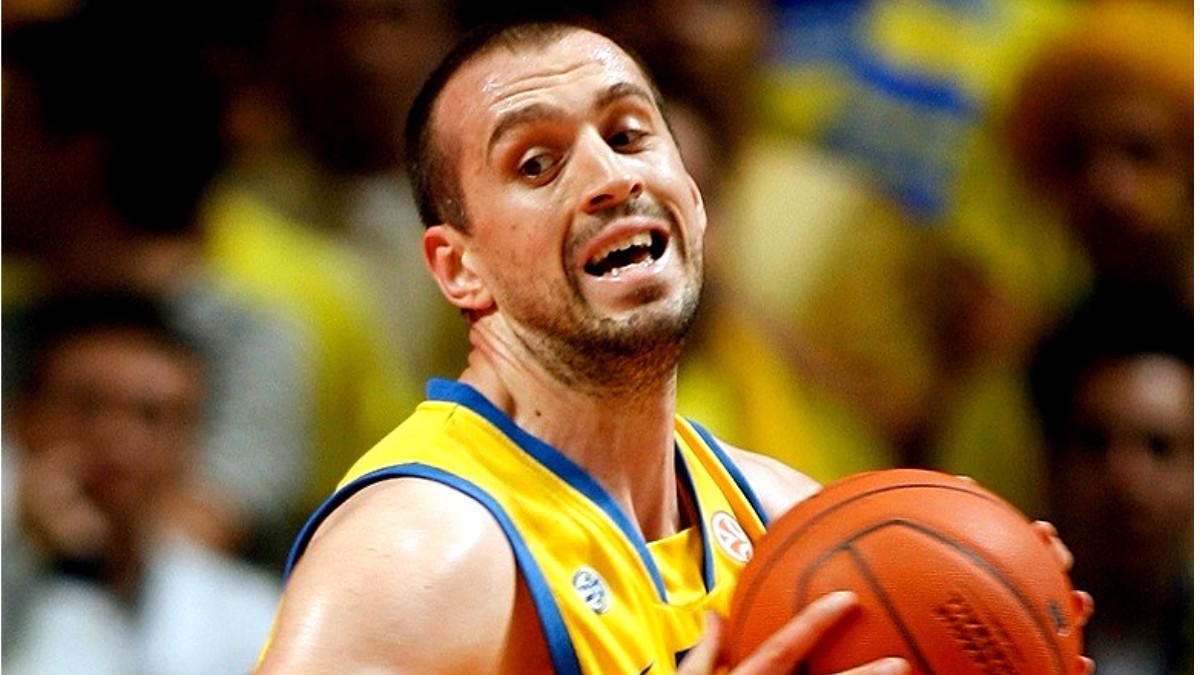
Nikola Vujčić was a different kind of center. Standing 6'11", he had the skills to score with his back to the basket and soft hands to finish near the rim, but his true talent lay in his understanding of the game. He saw cuts, anticipated help defense, and found passes that were normally beyond the reach of a player in his position. He could serve as an interior anchor while simultaneously orchestrating the offense from the high post.
He was neither the most athletic nor the most intimidating, but he turned intelligence into his greatest advantage. At Maccabi, which dominated Europe during the first half of the 2000s, his connection with Šarūnas Jasikevičius, Anthony Parker, and Maceo Baston placed him at the center of one of the most brilliant offenses EuroLeague has ever seen. Vujčić didn't just score: he made everything happen around him.
His career began at KK Split, the club from his homeland and one of the great historic names in European basketball. He made his debut in the 1995/96 season at age 17, averaging 5.6 points and 2.4 rebounds. He was still a young player in development, but already showed coordination and passing ability unusual for a big man of his size.
Vujčić arrived, moreover, backed by an impressive track record in youth categories. In 1995 he was champion and MVP of the U-16 European Championship with Croatia, and a year later he won gold again at the U-18 European Championship. From an early age he was considered one of the great talents of a Croatian generation seeking to inherit the legacy of previous years.
In the 1996/97 season he raised his averages to 6.8 points and 3.2 rebounds and won the Croatian Cup. His role was still not primary, but he was beginning to get more minutes and participate in building the offense, not just finishing near the basket. That cup title was the first of his professional career.
In 1997/98 he recorded 6 points and 4.4 rebounds. His progression seemed to advance at a certain pace, though each season he incorporated new elements. He could now receive away from the basket, put the ball on the floor, and punish with passes from positions where most centers only looked to score.
The breakthrough came in the 1998/99 season, when he reached 10.2 points and 5.1 rebounds. Vujčić stopped being merely an interesting prospect and began to become a reference point for Split. His team didn't have the stature of the Jugoplastika that had dominated Europe a decade earlier, but it remained an ideal environment for developing players with solid collective understanding.
In 1999/00 he exploded definitively. He averaged 17.3 points and 7.3 rebounds and became one of the most productive big men in the Croatian championship. His game no longer depended solely on technique near the basket: he could create from the post, assist shooters, and attack from perimeter positions.
During the 2000/01 season he maintained a high level, with 16 points and 5.5 rebounds. After six seasons with Split's first team, he was ready to leave Croatia. He had arrived as a teenager and was leaving as a complete center, with international experience and prepared to compete in more demanding projects.
In 2001 he was signed by Maccabi Tel Aviv, though the configuration of the Israeli roster eventually led to him being loaned to ASVEL Villeurbanne. The move proved fundamental for his growth. France offered him a competitive team and a context in which he could assume responsibilities from the start.
In the 2001/02 season he averaged 13.8 points and 6.9 rebounds and led ASVEL to the French championship. Villeurbanne had been chasing that title for years and Vujčić became one of the main pieces of a team that ended the drought. His time in France lasted just one season, but it finished proving that his game could work outside Croatia.
Maccabi brought him back in 2002. During the 2002/03 season he posted 14.8 points and 7.5 rebounds and won the Israeli League and Cup. His adaptation was immediate. The team found in him a center capable of scoring, rebounding, and facilitating the game of perimeter players from the paint. He was the big man the club needed, built to dominate in Israel and compete again in Europe.
The 2003/04 season marked the beginning of a historic era. Vujčić averaged 15 points and 7 rebounds and won the League and Cup again. Maccabi, coached by Pini Gershon and featuring Jasikevičius, Parker, Baston, Tal Burstein, and Derrick Sharp, deployed fast, generous basketball that was difficult to defend.
Vujčić was the link between all those pieces. He could finish the pick-and-roll with Jasikevičius, find Parker's cuts, or lob the ball for Baston. He didn't hold the ball and rarely needed to force a shot. The offense moved naturally because his center was capable of thinking and passing like a point guard.
The Final Four was held in Tel Aviv, with enormous pressure surrounding the host team. Maccabi beat CSKA in the semifinals and demolished Skipper Bologna 118-74 in the final, one of the greatest offensive displays in competition history. Vujčić lifted his first EuroLeague title, now established as the tactical center of a team that had found a different way to attack.
In 2004/05 he maintained his excellence with 13.6 points and 6.5 rebounds. Maccabi won the League and Cup again and defended their European crown. The team had lost the surprise factor, but continued playing at a pace and with ball movement that few rivals could withstand.
At the Final Four in Moscow, Maccabi eliminated Panathinaikos and defeated Baskonia in the title game. Vujčić again occupied a central role, providing interior play and passing ability that punished any defensive help. Maccabi became the first club to win back-to-back EuroLeagues since Jugoplastika Split, precisely the team that had shaped Vujčić's basketball childhood.
The 2005/06 season produced 14.9 points and 5.5 rebounds, plus another Israeli League and Cup. Vujčić was named to the EuroLeague All-Star Five for the second consecutive year and had a moment that fully defined his uniqueness.
Against Prokom Trefl he recorded 11 points, 12 rebounds, and 11 assists, becoming the first player in the modern EuroLeague era to achieve a triple-double. He hadn't reached that figure by accumulating blocks, as might be expected of a center, but by distributing eleven assists. It was the perfect expression of his game: an interior player capable of controlling a game through creation.
Maccabi reached the European final again and came close to completing three consecutive titles, but CSKA Moscow under Ettore Messina prevailed 73-69 in Prague. The loss closed the team's most brilliant cycle, with Jasikevičius already out of the roster, though Vujčić remained one of the continent's best centers.
In the 2006/07 season he averaged 11.5 points and 5.1 rebounds and won his fifth consecutive Israeli League title. His domestic production declined, but in EuroLeague he maintained extraordinary form, with 14.9 points, 7.6 rebounds, and 3.9 assists. He was selected for the third consecutive year to the competition's All-Star Five.
That season he made history again. Against Olimpija Ljubljana he posted 27 points, 10 rebounds, and 10 assists, completing the second triple-double of his career. For many years, Vujčić was the only player to achieve one in the modern EuroLeague, and he had done it twice.
Maccabi couldn't return to the Final Four. After beating CSKA in Tel Aviv, they lost the third and decisive quarterfinal game in Moscow. It was the first season since 2003 that the Israeli team failed to reach the title game.
The 2007/08 season was much more complicated for Vujčić. Injuries limited his participation and his averages dropped to 8.6 points and 3.7 rebounds. Still, he returned in time to help Maccabi in the final stretch of EuroLeague.
The Tel Aviv team reached the final again, after beating Montepaschi Siena in the semifinals, but faced CSKA once more. The Russian team won the title and Vujčić closed his Israeli chapter without adding a third EuroLeague crown. He left after six seasons, with two European titles, five League championships, and four Israeli Cups.
In 2008 he signed with Olympiacos. In his first season in Greece he averaged 8.8 points and 3.7 rebounds. He no longer had the same mobility of his best years, but retained his touch, reading of the game, and ability to organize from the post. His arrival helped the Piraeus club return to a EuroLeague Final Four after a decade's absence.
Olympiacos fell in the semifinals to Panathinaikos, in a duel decided in the final seconds, but Vujčić had competed again among Europe's top four. In EuroLeague he produced 11.4 points, 3.8 rebounds, and 2.6 assists, numbers that reflected his influence went beyond scoring.
During the 2009/10 season he contributed 7.4 points and 2.5 rebounds and won the Greek Cup, defeating Panathinaikos in the final. Olympiacos also returned to the EuroLeague title game, after beating Partizan in a semifinal decided in overtime.
Barcelona prevailed in the Paris final and Vujčić came up short of his third European crown. His role was now more limited, but he remained a useful piece in a roster featuring Miloš Teodosić, Theo Papaloukas, Josh Childress, Linas Kleiza, and Sofoklis Schortsanitis.
In the 2010/11 season he initially returned to Split. He played just two games, with impressive 17 points and 6 rebounds, before accepting an offer from Efes Pilsen. In Istanbul he averaged 8.1 points and 3.4 rebounds, though he no longer managed to regain the consistency of his best seasons. In EuroLeague he contributed 6.5 points, 3.1 rebounds, and 2 assists.
His definitive return home came in the 2011/12 season. With Split he averaged 11.2 points and 5.5 rebounds. He was no longer the young player seeking to make his way, but a veteran willing to help a club facing significant economic and sporting difficulties.
In 2012/13 he still produced 11.9 points and 4.7 rebounds. At 35 years old he maintained intact his ability to read the game, distribute from the post, and exploit any advantage near the basket. At the end of the season he announced his retirement, closing his career at the same club where he had started it eighteen years earlier.
His honors include a Croatian Cup, a French League title, five Israeli League championships, four Israeli Cups, a Greek Cup, and two EuroLeagues. He was selected three times to the EuroLeague All-Star Five and was part of the All-Decade Team for 2000-2010. In 2022 he received the distinction of EuroLeague Basketball Legend, recognition of one of the players who best represented the early years of the modern competition.
But his true legacy lies beyond titles alone. Vujčić expanded the possibilities of his position. He proved that a center could direct the offense without bringing the ball up, control the tempo without playing point guard, and find teammates before the defense even understood what was happening.
Nikola Vujčić didn't dominate through strength or athleticism. He did it through his mind. He'd receive at the high post, observe for an instant, and turn any defensive movement into an opportunity. He was the center who gave meaning to Maccabi's most brilliant years and one of the big men with the greatest passing talent European basketball has ever known.


