


 Latest:

 jun 01 2026
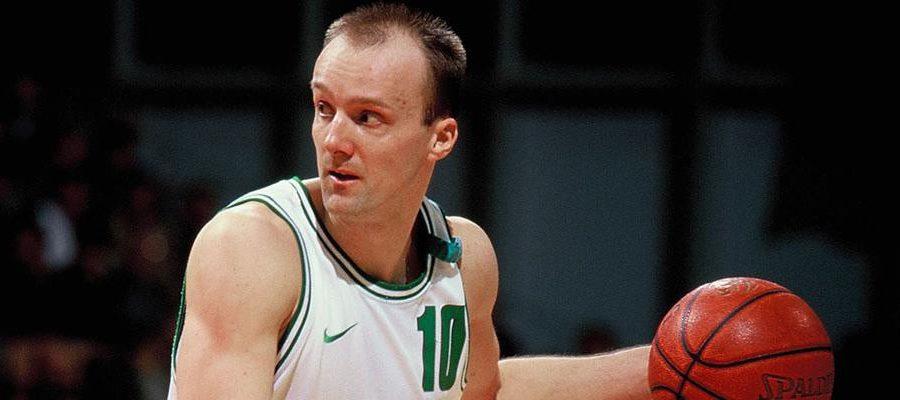
Jure Zdovc didn't need to dominate the ball for twenty seconds or rack up assists to control a game. He did it through reading, organization, and a defensive intelligence uncommon for a point guard of his era. At 1.96 meters tall, he could pressure the opposing playmaker, switch onto taller players, and turn every possession into an uncomfortable battle. He wasn't the most imaginative point guard or the most brilliant scorer of his generation, but he was one of the most reliable. A player built to compete and to win.
His career began early at Olimpija Ljubljana. He made his debut in the 1983/84 season at just 17 years old, averaging 2.3 points. He was still a young player trying to find his place, but the club already saw special qualities in him. In 1984/85, he raised his numbers to 3.5 points and 1.4 rebounds before beginning to assume a much more important role.
The progression was constant. In 1985/86, he reached 8.9 points and 1.8 rebounds, and a year later was producing 11.6 points and 2.5 boards. Zdovc was becoming a complete point guard, capable of running the offense, scoring, and contributing physically on both ends of the floor.
The 1987/88 season confirmed his definitive breakthrough. He averaged 14.4 points and 2.9 rebounds with Olimpija and was part of the Yugoslav national team that won silver at the Seoul Olympics. At just 21 years old, he was already competing at the highest international level within a generation full of talent.
Far from settling, he continued to grow. In 1988/89, he posted 16.2 points and 3.3 rebounds and added gold at the European Championship to his resume. Yugoslavia was entering a period of dominance, and Zdovc occupied a fundamental place in that structure: he defended, provided balance, and perfectly understood what the team needed at each moment.
In 1989/90, he maintained his production with 15.9 points and 3.4 rebounds. That season ended with Yugoslavia crowned world champions, another success that placed Zdovc among the great European point guards of his generation. He wasn't the player who grabbed the most headlines on a national team where some of the greatest stars in continental history played, but his presence helped everything function.
His final season of that first stint at Ljubljana was also one of his best. In 1990/91, he reached 16.7 points and 3.9 rebounds and won European gold again with Yugoslavia, a medal that war would make his final one in the blue jersey. At 24 years old, he had already won a World Championship, two European Championships, and an Olympic silver medal. His international career had reached an extraordinary dimension.
In 1991, he made the jump to Italy to play for Virtus Bologna. There he averaged 14.2 points and 3.2 rebounds during the 1991/92 season. The change of league didn't alter his performance. Zdovc remained a solid, physical, and competitive point guard, prepared to respond in an especially demanding Italian basketball environment.
His next destination was Limoges, where he would experience one of the most important moments of his club career. In the 1992/93 season, he contributed 12.6 points and 4.6 assists to a team that made defense, discipline, and control of tempo its main calling cards. It was the perfect setting for him.
That Limoges team won the French League and the European Cup, defeating Benetton Treviso in the final. Zdovc fit perfectly into the system: he defended the ball, maintained composure under pressure, and helped steer games toward a closed, tactical battlefield. He didn't need to score twenty points to be decisive. His influence was in the tempo, in the defense, and in the security he transmitted to the team.
After European success, he began a long stint in Greece with Iraklis. In 1993/94, he averaged 16 points and 2.9 assists, confirming that he could also assume elevated offensive responsibility. A year later he improved further: 17.4 points and 3.2 assists, his best scoring figures outside Slovenia.
In the 1995/96 season, he maintained a relevant role with 13.3 points and 2.5 assists. His performance during those years established him as one of the most respected foreign point guards in the Greek championship. He was a regular, serious player capable of adapting to different contexts without losing his identity.
The 1996/97 campaign was split between two teams. He started at Iraklis, where he recorded 8.7 points and 2 assists, and finished at Paris Basket Racing. In France, he averaged 9.8 points and 3.4 assists and won the League title again. It was his second French championship, after the one he won with Limoges.
After his years abroad, Zdovc returned to Olimpija Ljubljana. In the 1998/99 season, he still delivered important performance: 11.9 points and 2.1 rebounds, plus winning the Slovenian League and Cup. The return wasn't only sentimental. He came back to compete and to keep winning.
In 1999/00, he averaged 9.7 points and 3 assists and lifted another Slovenian Cup. His numbers were beginning to decline, but his experience and knowledge of the game continued to make him a useful piece for a team accustomed to fighting for all national titles.
The 2000/01 season he played in Greece with Panionios. There he produced 11.1 points and 3.1 assists, proving he still had the level to compete in one of Europe's most physical and demanding leagues.
A year later he returned once again to Olimpija. Already 35 years old, he averaged 6.6 points and 2.1 assists during a historic campaign for the club, which won the Slovenian League, Cup, and Adriatic League. Zdovc was no longer the scoring point guard of his youth, but he continued to provide experience, defense, and control in important moments.
His final professional season, 2002/03, again reflected his ability to extend his career without losing competitiveness. He started at Split, with whom he averaged 8.3 points and 2 assists and won the Croatian League. He then finished the season at Slovan Ljubljana.
There, in just two games and at 37 years old, he posted a surprising 25 points and 4 assists per game average. It was a final display of competitive pride before leaving the court. Even at the end, Zdovc kept finding ways to leave his mark.
His trophy case includes two French Leagues, two Slovenian Leagues, three Slovenian Cups, one Croatian League, one European Cup, and one Adriatic League. With the Yugoslav national team, he won one World Championship, two European Championships, and one Olympic silver medal.
However, his importance cannot be measured solely through titles. Zdovc represented a type of point guard that is increasingly difficult to find: tall, strong, disciplined, and committed to defense. A playmaker who knew when to accelerate, when to slow down, and when to let others take the spotlight.
Jure Zdovc didn't govern games through spectacle. He did it through work, concentration, and knowledge of the game. He was the quiet balance of championship teams, the defender who wore down opponents, and the point guard who rarely made a wrong decision.
A European and world champion who turned reliability into a form of excellence.


