


 Latest:

 jun 01 2026
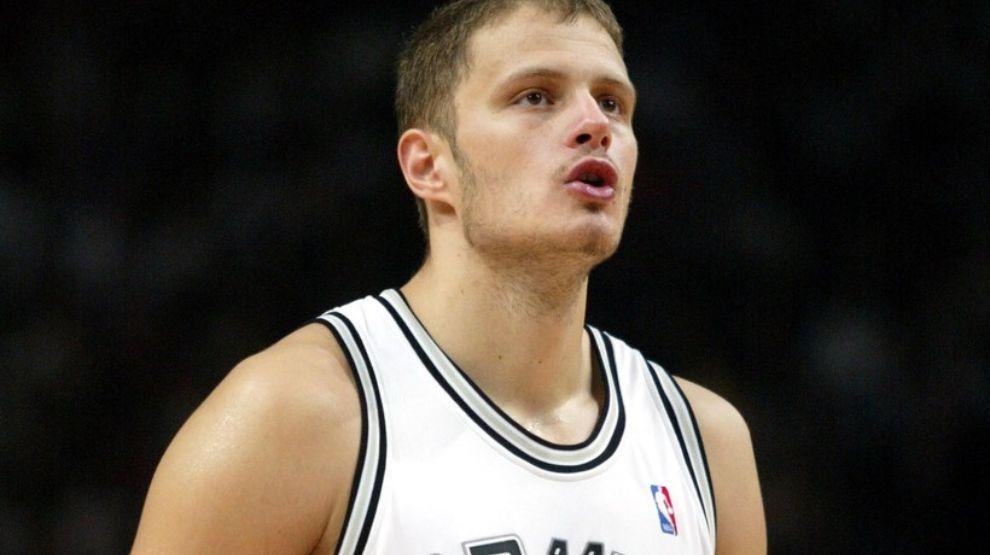
Radoslav Nesterović was never a center built to grab attention. He didn't play above the rim, didn't demand twenty shots, and rarely emerged as his team's star player. His value lay in positioning, size, defense, and a straightforward understanding of the game. He set solid screens, protected the paint, occupied the right spaces, and knew how to finish without needing much of the ball. He was one of those big men whose importance was better understood by watching how his team functioned than by looking at his statistics alone.
Standing 2.13 meters tall with notable coordination, "Rasho" grew within European basketball until becoming an NBA starting center. He won the European Cup with Virtus Bologna and, years later, a championship ring with the San Antonio Spurs. Two titles that summarize a career built on consistency and quiet work.
His early steps were marked by the instability of the former Yugoslavia. While still very young, he passed through Belgrade and trained with Partizan before moving to Greece to escape the conflict. There he obtained Greek citizenship and used the surname Makris-Nesterović, a circumstance that allowed him to avoid taking up a foreign roster spot.
His professional debut came with PAOK Thessaloniki. In the 1993/94 season, at just 17 years old, he averaged 2.3 points and 1.5 rebounds. A year later he raised his numbers slightly to 3.1 points and 3 rebounds. His role was still small, but those two years allowed him to compete in a demanding environment and begin developing an interior game based more on technique and reading the game than on strength.
In 1995 he returned to Ljubljana to play for Olimpija. The homecoming accelerated his growth. In the 1995/96 season he reached 11 points and 5.2 rebounds and won the Slovenian League. That same year he was named MVP of the U-22 European Championship, averaging 10 points and 9.6 rebounds with Slovenia.
The 1996/97 season confirmed he was ready for another step up. He averaged 12.2 points and 6.3 rebounds, won the League again, and added the Slovenian Cup. Olimpija also reached the European Final Four, an extraordinary result for the club and for a generation that also featured Marko Milič and Vladimer Stepania. During that summer's EuroBasket, Nesterović produced 13.6 points and led the tournament with 8.6 rebounds per game.
His performance caught the attention of Virtus Bologna, one of the continent's major projects. He arrived in Italy in 1997 at age 21, surrounded by more experienced big men. He would later recall being called "Bimbo" and starting the season as the fifth center in the rotation. Players like Predrag Danilović and Zoran Savić were important in his adaptation and helped him understand the demands of a team built to win.
In the 1997/98 season he averaged 8 points and 6 rebounds and finished winning the Italian League and the European Cup. His influence grew in the decisive moments. In the continental semifinal against Partizan he scored 14 points without a miss—7 of 7—while in the final against AEK he contributed 6 points and 9 rebounds. Virtus won 58-44 and lifted the first European Cup in club history.
A year later he assumed much greater responsibility. In 1998/99 he raised his averages to 14.1 points and 6.1 rebounds and won the Italian Cup. In European competition he produced 12.8 points and 6.1 rebounds, becoming a key interior reference for Virtus. Bologna reached the continental final again, though this time was beaten by Žalgiris.
Minnesota Timberwolves had selected him with the 17th pick of the 1998 Draft, but Nesterović remained in Bologna for much of that season, also marked by the NBA lockout. He finally joined Minnesota in May 1999 and could only play two games, averaging 4 points and 4 rebounds.
His adaptation to American basketball was gradual. In the 1999/00 season he posted 5.7 points and 4.6 rebounds. In 2000/01 he dropped to 4.5 points and 3.9 rebounds, but continued earning minutes thanks to his defensive discipline and ability to share the paint with Kevin Garnett.
His consolidation began in 2001/02, when he reached 8.4 points and 6.5 rebounds. He was already a regular starter, a center who freed Garnett from much of the defensive wear against bigger interior players and who didn't need offensive prominence to help the team.
During that period he was also Slovenia's primary interior reference. At the 2001 EuroBasket he averaged 15.7 points and 9 rebounds, with performances of 20 points and 11 rebounds against Turkey and 19 and 12 against Latvia.
The 2002/03 season was the best of his Minnesota career. He averaged 11.2 points and 6.5 rebounds, shooting 52.5% from the field, and definitively established himself as an NBA starting center. He finished well near the basket, had a reliable shot from four or five meters out, and provided constant defensive presence.
At the end of that campaign he signed as a free agent with the San Antonio Spurs. The Texans had just released David Robinson and were looking for a big man capable of accompanying Tim Duncan without disrupting the team's balance. Nesterović fit that description perfectly: he didn't demand the ball, he defended, and he understood team basketball.
In the 2003/04 season he averaged 8.7 points and achieved the best rebounding mark of his career, with 7.7 captures. He was a starter on a team whose identity was born from defense, directed by Gregg Popovich and built around Duncan.
A year later his numbers dropped to 5.9 points and 6.6 rebounds, but the title missing from his career arrived. San Antonio defeated Denver, Seattle, and Phoenix before beating the Detroit Pistons in a tight Finals series. Nesterović lost prominence during the playoffs with the emergence of Nazr Mohammed, but he was part of the structure that had carried the Spurs to the championship. In 2005 he became an NBA champion, seven years after winning Europe with Virtus.
The 2005/06 season was his last in San Antonio. He averaged 4.5 points and 3.9 rebounds, with an increasingly reduced role. In the summer of 2006 he was traded to the Toronto Raptors in exchange for Matt Bonner, Eric Williams, and a future second-round pick. Bryan Colangelo highlighted his intelligence and the defensive impact he could provide.
In his first year in Canada he posted 6.2 points and 4.5 rebounds. Toronto won the Atlantic Division and returned to the playoffs, while Nesterović provided experience and balance around Chris Bosh. In 2007/08 he improved to 7.8 points and 4.8 rebounds, remaining a useful big man even as the NBA's pace began to change.
With the national team he continued serving as captain and reference point. He averaged 12 points and 7.2 rebounds at the 2006 World Championship and 11.9 points and 7.6 rebounds at the 2007 EuroBasket, where Slovenia finished seventh after starting the tournament with six consecutive victories.
In 2008 he was traded to the Indiana Pacers in the deal that sent Jermaine O'Neal to Toronto. During the 2008/09 season he averaged 6.8 points and 3.4 rebounds. He was no longer an undisputed starter, but he retained his touch near the basket and the ability to provide reliable minutes off the bench.
After just one season in Indiana he returned to Toronto. In 2009/10 his role was much more limited: 3.9 points and 2.1 rebounds. At 34 years old, and after more than a decade in the United States, his NBA era had come to an end.
Nesterović closed his American career with 811 games and averages of 6.8 points, 5.1 rebounds, and one block per game. He was never a star, but he remained for eleven full years in a league that demands European centers adapt physically and mentally. He was a starter alongside Kevin Garnett and Tim Duncan, two of the best big men of his generation, and knew how to find his place without competing with them for prominence.
In 2010 he decided to return to Europe and signed with Olympiacos. Far from simply playing out a final season, he still produced 9.6 points and 4.6 rebounds in Greek competition. In the EuroLeague he raised his numbers to 10.9 points and 5.4 rebounds, shooting 67.6% on two-pointers. At 35 years old he remained an effective interior player and difficult to move near the basket.
His farewell came with one final title. Olympiacos won the Greek Cup and Nesterović ended a career that had begun nearly two decades earlier in Thessaloniki.
His trophy case includes two Slovenian Leagues, one Slovenian Cup, one Italian League, one Italian Cup, one Greek Cup, one European Cup, and one NBA championship.
Radoslav Nesterović was not a dominant center or a player destined to fill highlight reels. He was something harder to maintain for so many years: a reliable professional. He understood early that his career would not depend on accumulating points, but on making the teams he played for better.
He won in Ljubljana, in Bologna, in San Antonio, and in Piraeus. Always in a similar way: defending, occupying his space, and accepting the work his team needed. Discretion was his style, but also the reason he managed to remain among the best for so long.


