


 Latest:

 jun 01 2026
Some players dominate one specific aspect of the game. Andrei Kirilenko seemed present in all of them. He scored without needing many shots, rebounded, passed, ran the floor, stole the ball, and appeared from anywhere to block a shot. At 6'9", with endless arms and mobility unusual for his height, he was one of the most versatile defenders of his generation.
His game didn't quite fit traditional positions. He could play as a small forward or power forward, defend from point guards to centers, and finish a night with numbers across every statistical column. That's why his games weren't always understood by looking solely at points. Kirilenko could dominate without being the leading scorer, turning activity, anticipation, and defensive intelligence into a different way of controlling basketball.
His professional career began at Spartak Saint Petersburg. In the 1996/97 season, at just 15 years old, he averaged 7.6 points and 3.2 rebounds. He was the youngest player to debut in Russia's top competition at that time, an extraordinarily early start even for someone who had grown much faster than his peers.
In 1997/98 he elevated his numbers to 12.2 points and 4.5 rebounds. He was no longer simply a teenager used to fill out the rotation. His ability to impact both sides of the floor began turning him into one of the most interesting talents in Russian basketball.
CSKA Moscow signed him in 1998. During his first season in the capital he averaged 10.2 points and 3.5 rebounds and won the Russian League. Utah Jazz selected him with the 24th pick of the 1999 Draft when he was still 18 years old, but both sides understood it was best for him to continue developing in Europe before making the jump to the NBA.
In the 1999/00 season he contributed 11.4 points and 4.1 rebounds and won the Russian championship again. CSKA also won the Northern European League, the NEBL, a competition that brought together clubs from different Baltic and northern continental countries.
His final campaign before heading to the United States was the most complete. In 2000/01 he reached 14.1 points and 8.6 rebounds, already assuming much greater responsibility. Kirilenko had also debuted with the national team and, at 19 years old, competed in the Sydney Olympics. When he arrived in the NBA, he wasn't an inexperienced project but a player who had accumulated five professional seasons and international games with Russia.
In the 2001/02 season he definitively joined Utah Jazz. There he found a locker room still led by John Stockton and Karl Malone, two legends who had been playing together for more than a decade under Jerry Sloan's orders. Kirilenko had to quickly learn the toughness of the system, the defensive demands, and a way of competing that didn't allow relaxation on any possession.
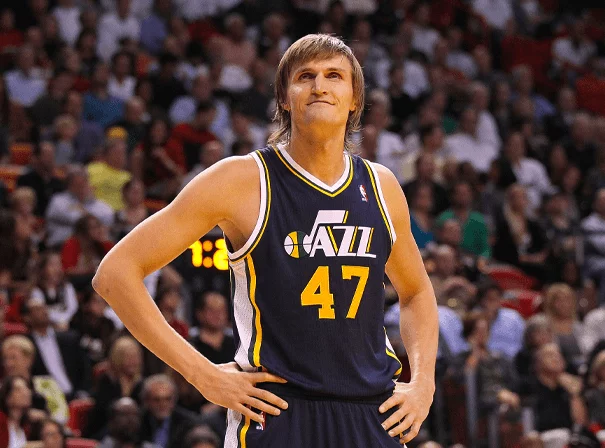
His adaptation was immediate. He averaged 10.7 points, 4.9 rebounds, 1.9 blocks, and 1.4 steals, making the All-Rookie team. His number 47, combined with his initials, gave rise to the nickname that would follow him throughout his career: AK-47. It wasn't just a play on words. His speed to impact, his reach, and the ease with which he altered possessions made the nickname fit his style of play.
In 2002/03 he improved to 12 points and 5.3 rebounds. He continued playing a secondary role around Stockton and Malone, but it became increasingly evident that Utah had in him the player on which it could build the team's next phase.
That transition came in the summer of 2003. Stockton retired and Malone left the franchise to sign with Los Angeles Lakers. Without their two great references, many expected Utah to collapse. Kirilenko responded with the best season of his career: 16.5 points, 8.1 rebounds, 3.1 assists, 1.9 steals, and 2.8 blocks.
He was selected for the first and only time to the All-Star Game and made the NBA's All-Defensive Second Team. In December 2003 he recorded two 5x5 games in just one week. Against Houston he finished with 19 points, 5 rebounds, 7 assists, 8 steals, and 5 blocks; against New York he added 10 points, 12 rebounds, 6 assists, 6 steals, and another 5 blocks. It was the clearest demonstration of his game: he didn't need to choose just one way to have an impact.
In the 2004/05 season he maintained an extremely high level, with 15.6 points, 6.2 rebounds, and 3.3 blocks. Injuries limited his participation, but even so he finished as the NBA leader in blocks per game and was selected again for the All-Defensive Second Team. Kirilenko protected the rim without being a traditional center: many times he arrived from the weak side, waited for the last instant, and used his length to correct his teammates' mistakes.
The 2005/06 campaign was possibly the best expression of his versatility. He averaged 15.3 points, 8 rebounds, 4.3 assists, and over three blocks. He became the fourth player in history to reach in the same season at least 15 points, 8 rebounds, 4 assists, and 3 blocks per game, after Kareem Abdul-Jabbar, Bob Lanier, and David Robinson. He was included in the All-Defensive First Team and led the NBA in total blocks.
That season left several performances difficult to repeat. Against the Lakers he completed the third 5x5 of his career with 14 points, 8 rebounds, 9 assists, 6 steals, and 7 blocks. Later, against Sacramento, he recorded a triple-double of 15 points, 14 rebounds, and 10 blocks, his best shot-blocking performance in the NBA.
In 2006/07 his role changed. The recovery of Carlos Boozer, the growth of Mehmet Okur, and the emergence of Deron Williams shifted the offensive focus to other players. Kirilenko dropped to 8.3 points and 4.7 rebounds, a reduction that was hard for him to accept after having been the team's main reference. Utah, however, completed an excellent season and reached the Western Conference Finals.
That summer he recovered his best form with Russia. At the 2007 EuroBasket held in Spain he averaged 18 points, 8.6 rebounds, and 2.4 assists. Kirilenko was the centerpiece of a team coached by David Blatt that advanced to a final where the host nation, world champion and heavy favorite, awaited.
Russia won 60-59 thanks to J.R. Holden's final basket. Kirilenko finished with 17 points, 5 rebounds, 2 assists, 1 steal, and 1 block and was named tournament MVP. The gold represented Russia's first major title since the Soviet Union's dissolution and the greatest international success of his career.
In the 2007/08 season he found a more balanced role in Utah again. He averaged 11 points and 4.7 rebounds, but his contribution wasn't limited to those numbers. Jerry Sloan used him as the primary defender, passer from the high post, and a piece capable of covering the spaces left by Williams, Boozer, and Okur.
In 2008/09 he maintained similar production, with 11.6 points and 4.7 rebounds. He alternated between starting and coming off the bench and continued contributing in several positions, although injuries and accumulated wear already prevented him from maintaining the physical activity of his best years throughout the entire season.
The 2009/10 campaign produced 11.9 points and 4.6 rebounds. Kirilenko remained one of the most difficult players to replace within Utah's system: he could initiate the fast break after a rebound, cut without the ball, find the open teammate, and defend the opposing team's primary perimeter player.
In 2010/11 he averaged 11.7 points, 5.1 rebounds, and 3 assists. It was his tenth and final season with the Jazz. He closed that chapter with 681 regular season games, averaging 12.4 points, 5.6 rebounds, 2.8 assists, 1.4 steals, and 2 blocks. Only Mark Eaton finished his career in Utah with more blocks than Kirilenko.
During the summer of 2011 he led Russia again at EuroBasket. He averaged 14.9 points, 6.1 rebounds, and 2.3 assists and led the team to a bronze medal. Russia lost only one game throughout the championship, the semifinal against France, before defeating Macedonia in the third-place game.
The NBA lockout facilitated his return to CSKA Moscow in the 2011/12 season. Kirilenko had offers to return to the United States when the conflict was resolved, but decided to finish the season in Russia. He averaged 12.6 points and 5.9 rebounds across all competitions, while in the EuroLeague he elevated his numbers to 14.1 points, 7.5 rebounds, 1.9 blocks, and 1.5 steals.
He was named EuroLeague MVP, Defensive Player of the Year, and made the All-EuroLeague Team. He also led the competition in rebounds and blocks and helped CSKA win the Russian League and VTB League. He was only missing the European title: the Russian team squandered a 19-point lead in the final against Olympiacos and lost 62-61 after Georgios Printezis' basket in the final second.
His year ended with another international success. At the London Olympics, Kirilenko produced 17.5 points and 7.5 rebounds and led Russia to a bronze medal. In the decisive game they defeated Argentina, completing a period in which the national team had won the 2007 EuroBasket, the 2011 European bronze, and the 2012 Olympic bronze.
In the 2012/13 season he returned to the NBA to play with Minnesota Timberwolves. He averaged 12.4 points and 5.7 rebounds, sharing a team with Kevin Love, Ricky Rubio, and his compatriot Alexey Shved. At 31 years old he still retained his ability to connect defense with offense and make lineups function without needing specific plays for him.
A year later he signed with Brooklyn Nets. In 2013/14 his numbers dropped to 5 points and 3.2 rebounds, limited by injuries and a much reduced role on a veteran team that featured Kevin Garnett, Paul Pierce, Deron Williams, and Joe Johnson.
The 2014/15 season began the same way. He appeared in only seven games with Brooklyn and averaged 0.4 points. He was traded to Philadelphia, though he never played a game with the Sixers. In February he returned to CSKA to finish his career where he had begun competing at the highest level.
With the Moscow team he contributed 8.9 points and 4.4 rebounds and won the VTB League again. CSKA also reached the EuroLeague Final Four, though it fell to Olympiacos again in the semifinals. At the end of the season, at 34 years old, Kirilenko announced his retirement.
His trophy case includes three Russian Leagues, one NEBL title, and two VTB League championships. With Russia he won one European gold and one bronze, plus an Olympic bronze medal. He was an NBA All-Star, a member once of the All-Defensive First Team and twice of the All-Defensive Second Team, led the league in blocks, and was selected to the All-Rookie Team. In Europe he added the EuroLeague MVP and Defensive Player of the Year award from 2012.
But his true importance lies in how he anticipated the basketball that would come later. Kirilenko could switch defensively, protect the rim, handle the ball, pass, and play without occupying a fixed position. For years his ability to fill up the stat sheet was valued; over time it became clear that what was extraordinary was how he connected all those actions.
Andrei Kirilenko didn't need to control the ball to control the game. It was enough to follow him during one possession: he helped in the paint, recovered his man, deflected a pass, ran the fast break, and finished by assisting a teammate. He seemed to be everywhere because, during his best years, he almost always was.


