


 Latest:

 jun 01 2026
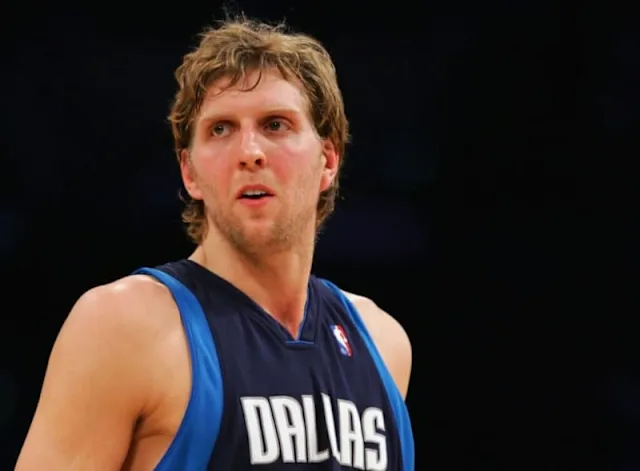
Dirk Nowitzki changed how the world understood big men. Before his arrival, a 7-foot player was expected to live near the basket, crash the boards, and score with his back to the defense. He did almost the opposite. He ran the floor, dribbled like a guard, shot from anywhere, and turned his one-legged fadeaway into one of basketball's most iconic moves.
His revolution didn't come from raw power or an overwhelming personality. Nowitzki dominated through technique, consistency, and an uncanny ability to always find the spot from which he could shoot without the defender bothering him. For 21 seasons he wore only a Dallas uniform, endured painful defeats, and waited until age 32 to complete one of the greatest careers in European basketball with an NBA championship.
His story began in Würzburg. Before focusing on basketball, he had played tennis and handball—two sports he would later credit with developing his coordination, footwork, and body control. Everything changed around age 15 when he met Holger Geschwindner, a former German international, physicist, and coach with unconventional methods.
Geschwindner didn't want to build a traditional center. He had Nowitzki work on balance, coordination, and rhythm, organized training sessions accompanied by saxophone music, and replaced some of the usual gym work with exercises like rowing on a lake. His goal was for Nowitzki to understand basketball as continuous movement, almost like a form of dance. That relationship between coach and player would last throughout his entire career.
In the 1996/97 season, at just 18 years old, Nowitzki was already averaging 28.1 points and 10.5 rebounds with Würzburg. He wasn't yet competing in Germany's top division, but it was clear that this exceptionally tall power forward, capable of bringing the ball up and shooting from outside, was far above the level of competition.
A year later he elevated his numbers to 29.3 points and 11 rebounds. His growth led Würzburg to promotion and began attracting American scouts. The moment that truly changed his career came in March 1998 during the Nike Hoop Summit. Against some of the best young American players, Nowitzki scored 33 points and grabbed 14 rebounds, leading the international team to victory. He went from being an unknown prospect in Germany to becoming one of the names for the upcoming Draft.
Milwaukee selected him ninth overall in 1998, but his rights were immediately sent to Dallas along with Pat Garrity's in exchange for Robert Traylor. Don Nelson and his son Donnie had been following the German for some time and were convinced that this player could transform the game.
A lockout delayed the start of the 1998/99 season and allowed Nowitzki to continue a few more months in Würzburg, now in the top division. There he averaged 22.9 points and 8.4 rebounds before receiving the final call from Dallas.
His first year in the NBA was much more difficult. He arrived at 20 years old with a body still too thin and little experience against players of that caliber. In his debut he missed all five field goal attempts and finished with two points. He closed the season with 8.2 points and 3.4 rebounds, struggling to adapt to the pace, the physicality, and life away from Germany. He even considered going back home.
The transformation began in the 1999/00 season. Nowitzki elevated his averages to 17.5 points and 6.5 rebounds and became a regular starter. Alongside Steve Nash and Michael Finley, he began forming the core of a Mavericks team that had been away from the playoffs for years.
In 2000/01 he reached 21.8 points and 9.2 rebounds and was named to the All-NBA Third Team. Dallas returned to the playoffs after eleven years and Nowitzki stopped being viewed as a European curiosity. He was already a rising star and one of the most difficult big men to defend because of his ability to shoot, penetrate, and run the floor.
The 2001/02 season confirmed his arrival among the elite. He averaged 23.4 points and 9.9 rebounds, made his first All-Star appearance, and was named to the All-NBA Third Team again. His game was beginning to change defenses: centers couldn't follow him away from the paint and small forwards lacked the height to stop his shot.
That summer he led Germany to bronze at the Indianapolis World Championship. Nowitzki produced 24 points and 8.2 rebounds per game, finished as the tournament's leading scorer, and was named MVP. Germany achieved the first World Championship medal in its history around a player who now had to face defenses built almost exclusively to stop him every night.
In 2002/03 he continued to grow: 25.1 points and 9.9 rebounds, another All-Star selection, and a spot on the All-NBA Second Team. Dallas reached the Western Conference Finals, but Nowitzki suffered a knee injury in the third game against San Antonio and didn't play the rest of the series. The Mavericks managed to extend the series to six games, but ultimately fell to the eventual champion.
The 2003/04 season produced 21.8 points and 8.7 rebounds, his third consecutive All-Star selection and another All-NBA Third Team honor. Dallas played with a more offensive structure, but couldn't advance past the first round. Nowitzki, however, was already the figure around which the entire project was built.
In 2004/05 he took another step. He averaged 26.1 points and 9.7 rebounds, was named to the All-NBA First Team for the first time, and finished third in MVP voting. That season he scored 53 points against Houston, the best mark of his career.
During the summer of 2005 he delivered another great performance with Germany. He averaged over 25 points and 11 rebounds at EuroBasket and led a limited national team to the final. In the semifinals he hit the decisive shot against Spain, before losing to Greece in the gold medal game. Despite the loss, he was named MVP of the tournament.
In the 2005/06 season he produced 26.6 points and 9 rebounds and repeated on the All-NBA First Team. Dallas defeated San Antonio in a memorable seven-game series and reached the Finals for the first time. The Mavericks won the first two games against Miami and had a significant lead in the third, but Dwyane Wade changed the series. The Heat won four consecutive games and left Nowitzki facing the most painful defeat of his career.
His response during the 2006/07 season was extraordinary. He averaged 24.6 points, 8.9 rebounds, and 3.4 assists, shooting 50.2% from the field and 41.6% from three-point range. Dallas won 67 games and Nowitzki became the first European player trained entirely outside the United States to win the regular season MVP award.
But the award came with another blow. Golden State, coached by Don Nelson, eliminated the Mavericks in the first round. Dallas was the best team in the regular season and the Warriors had barely made the playoffs, but they won the series 4-2. Nowitzki collected his MVP a few days later, when the season was already over and the disappointment still weighed more than the recognition.
In 2007/08 he maintained his level with 23.6 points and 8.6 rebounds, returned to the All-Star Game, and was named to the All-NBA Second Team. Dallas acquired Jason Kidd seeking one final competitive push, though they fell in the first round again.
During the 2008/09 season he recovered some of his best offensive production: 25.9 points and 8.4 rebounds. He was an All-Star and returned to the All-NBA First Team. His game was increasingly relying on mid-post play and that fadeaway shot that would eventually become his signature.
In 2009/10 he posted 25 points and 7.7 rebounds, made another All-Star appearance, and earned All-NBA Second Team honors. Dallas won 55 games, but San Antonio eliminated him in the first round again. Nowitzki had accumulated great seasons, an MVP, and two painful playoff disappointments. At 32 years old, doubts were beginning to surface about whether he would have another real chance to win the championship.
The answer came in the 2010/11 season. His regular season averages—23 points and 7 rebounds—weren't the highest of his career, but his playoff performance reached another dimension. Dallas eliminated Portland, swept the defending champion Los Angeles Lakers, and defeated Oklahoma City to return to the Finals. Nowitzki averaged 32.2 points in the Western Conference Finals and in the first game scored 48 against the Thunder while missing just three shots.
In the Finals he faced Miami again, now reinforced by LeBron James and Chris Bosh. Nowitzki suffered a left hand tendon injury in the first game, led a 15-point fourth-quarter comeback in the second, and played the fourth quarter with a fever. Dallas reached the sixth game with a 3-2 series lead and closed it out in Miami.
Eleven years after leaving Würzburg, Dirk Nowitzki was an NBA champion. He averaged 26 points and 9.7 rebounds in the Finals and received the Finals MVP award. The image of Nowitzki leaving the court before the final game ended, seeking a few moments alone while his teammates celebrated, summed up the burden he had carried since the 2006 defeat.
The 2011/12 season, shortened by another lockout, produced 21.6 points and 6.7 rebounds. He was an All-Star and made the All-NBA Third Team, though Dallas couldn't maintain the level of the championship team and fell in the first round.
In 2012/13 a knee surgery delayed his season start. For the first time since his rookie year he fell below twenty points, averaging 17.3 with 6.8 rebounds. Dallas also missed the playoffs, ending a streak of twelve consecutive appearances.
Nowitzki responded in 2013/14 with 21.7 points and 6.2 rebounds and returned to the All-Star Game. The Mavericks made the playoffs and pushed the eventual champion San Antonio to seven games before falling.
In 2014/15 he averaged 17.3 points and 5.9 rebounds and made his thirteenth All-Star appearance. His mobility was no longer the same, but he continued to command defensive respect with his shot and found points through technique and basketball intelligence.
The 2015/16 season produced 18.3 points and 6.5 rebounds. At 37 years old he was still Dallas's leading scorer and kept the team in playoff contention. A year later, in 2016/17, his averages dropped to 14.2 points and 6.5 rebounds, but he reached 30,000 points in the NBA, a milestone that at that time only five players had surpassed.
In 2017/18 he contributed 12 points and 5.7 rebounds. He played all 77 games for which he was available and continued extending a career that had already exceeded any expectations born in Würzburg.
His final season, 2018/19, was affected by ankle surgery. He averaged 7.3 points and 3.1 rebounds and was specially invited to the All-Star Game alongside Dwyane Wade. On April 9, 2019, after Dallas's final home game, he announced his retirement. He was 40 years old, two months shy of 41.
Nowitzki departed after 21 seasons, all with the Mavericks, 1,522 games, and 31,560 points. He was a fourteen-time All-Star, twelve-time All-NBA selection, 2007 regular season MVP, and 2011 Finals MVP. Dallas retired his number 41 and his career was honored with induction into the Basketball Hall of Fame in 2023.
His resume includes one NBA championship, one World Championship bronze medal, and one European Championship silver medal. He was once NBA MVP, once Finals MVP, four times All-NBA First Team, five times All-NBA Second Team, three times All-NBA Third Team, and fourteen-time All-Star.
But his legacy transcends the awards. Nowitzki proved that a 7-foot player could thrive away from the basket without losing impact, be the primary offensive weapon for a champion, and build an entire career around shooting. After him, big men began to grow looking toward the perimeter.
Dirk Nowitzki arrived in Dallas as a skinny young man who doubted whether he was ready for the NBA. He left as the greatest player in franchise history and one of the most important Europeans basketball has ever known. He did it without changing teams, without abandoning his way of playing, and without stopping his work with that coach who once taught him to move to the rhythm of a saxophone.


