


 Latest:

 jun 01 2026
Hidayet Türkoğlu was one of those players difficult to fit into a specific position. Standing 2.06 meters tall with a small forward's frame, he understood the game like a point guard. He could shoot from outside, attack near the rim, or use his height against smaller defenders, but his true difference lay in his ability to create. With the ball in his hands, especially after a pick-and-roll, he knew how to wait, read the defense, and almost always make the right decision.
He wasn't quick or particularly explosive. His game depended on timing, ball-handling, and an intelligence that reached its peak in Orlando. There he became the offensive director of a team that reached the NBA Finals and one of the most influential European wings of his generation.
His career began very early at Efes Pilsen. In the 1995/96 season, at just 16 years old, he averaged 3.6 points and 2.5 rebounds on a team that won the Turkish League and Cup. His role was still limited, but his height, coordination, and unusual facility for playing facing the basket already stood out.
In 1996/97 he contributed 4 points and 2.6 rebounds and celebrated another League title. A year later he raised his numbers to 5.3 points and 3.8 rebounds, plus another Cup. Türkoğlu grew steadily, earning minutes with one of Turkey's most demanding clubs and progressively expanding his responsibilities.
The breakthrough came in the 1998/99 season. He averaged 10.1 points and 4.5 rebounds and stopped being merely a prospect to become an important piece of the first team. His ability to shoot over shorter opponents and to initiate the offense from the wing position began to attract attention outside Turkey.
In 1999/00 he reached 15.2 points and 5.8 rebounds, his best numbers with Efes. The Istanbul club reached the Final Four of Europe's top competition, finishing in third place. Türkoğlu confirmed he was ready to leave Europe and test himself in American basketball.
The Sacramento Kings selected him with the 16th pick in the 2000 Draft. He arrived at a team that fit well with his characteristics. Rick Adelman had built a roster in which passing and ball movement were fundamental, with players like Chris Webber, Vlade Divac, Peja Stojaković, Doug Christie, and Jason Williams.
In his first season he averaged 5.3 points and 2.8 rebounds. He didn't need to assume too much responsibility, but he began earning playing time thanks to his versatility and ability to play multiple positions. The NBA was a huge change, but the presence of Divac and Stojaković eased his adaptation to a new country and a much more physical competition.
During the summer of 2001 he became one of the main protagonists of the EuroBasket held in Turkey. He averaged 15.5 points, 5.8 rebounds, and 3.5 assists and helped the host nation win the first medal in its history at a major tournament. His best performance came in the semifinal against Germany, with 23 points, 11 rebounds, and 8 assists. Turkey lost the final to Yugoslavia, but that silver medal marked a before and after for the country's basketball.
Back in Sacramento, the 2001/02 season confirmed his progression. He averaged 10.1 points and 4.5 rebounds with a Kings team that won 61 games and reached the Western Conference Finals. Türkoğlu had to assume a larger role when Stojaković was injured and responded with 20 points and 13 rebounds in the game that clinched the series against Dallas. Sacramento was one win away from the Finals, but fell to the Los Angeles Lakers in seven games.
His role decreased in 2002/03. He finished the season with 6.7 points and 2.8 rebounds on a roster with a very deep perimeter rotation. Türkoğlu needed more touches and a context that better utilized his playmaking ability, so his time in Sacramento came to an end.
The 2003/04 season he spent with the San Antonio Spurs. He averaged 9.2 points and 4.5 rebounds and delivered one of his best versions as an outside shooter. Gregg Popovich used him as a wing and, at times, as a stretch power forward, though within such a structured system he didn't have the freedom to develop all his qualities.
In 2004 he signed with the Orlando Magic, the team that would define his career. During his first season he averaged 14 points and 3.5 rebounds. In 2005/06 he improved to 14.9 points and 4.3 rebounds, while in 2006/07 he maintained steady production with 13.3 points and 4 rebounds.
Until then he had been a good scoring wing, capable of spacing the floor and creating some possessions. Everything changed with the arrival of Stan Van Gundy to the bench. The coach understood that Türkoğlu could be much more dangerous if he received the ball away from the rim and directed the offense through the pick-and-roll.
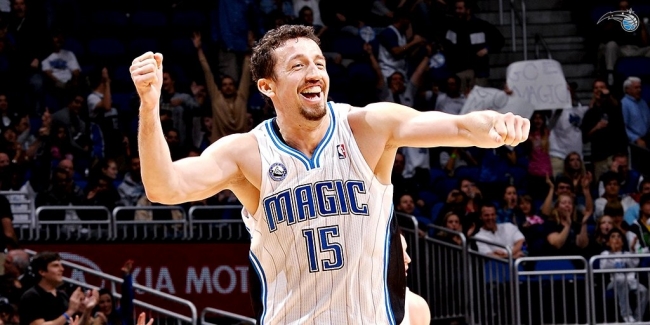
The 2007/08 season was the best of his career. He averaged 19.5 points, 5.7 rebounds, and 5 assists, reached the 40-point mark several times, and recorded his first triple-doubles. His combination with Dwight Howard became one of the foundations of Orlando's offense: if the defense collapsed on the center, Türkoğlu found the shooter; if it switched, he attacked the slower defender; and if given space, he shot from outside.
At 29 years old he was named NBA Most Improved Player. He hadn't appeared out of nowhere. He had been showing his qualities for years, but Orlando allowed him to have the ball and participate in important decisions. The award recognized both his statistical growth and his transformation into one of the league's most complete wings.
In 2008/09 his numbers dipped slightly to 16.8 points and 5.3 rebounds, but his influence on the game was even greater. Türkoğlu became the player who handled many of the crucial possessions. In the first round of the playoffs he hit the game-winning three-pointer in Game 4 against Philadelphia when Orlando was down in the series.
His big night came in Game 7 of the Eastern Conference Semifinals against Boston. The Celtics were defending champions and playing at home, but Türkoğlu delivered 25 points and 12 assists to lead a 101-82 victory. Orlando then eliminated LeBron James and the Cleveland Cavaliers and reached the NBA Finals.
The Magic lost 4-1 to the Los Angeles Lakers, but Türkoğlu had reached the peak of his career. He was no longer just a European wing with a good shot, but the primary offensive creator for a championship contender. During those playoffs he averaged 15.8 points, 4.5 rebounds, and 4.8 assists.
After that season he signed with the Toronto Raptors. The experience didn't work as expected. In 2009/10 he averaged 11.3 points and 4.6 rebounds, far from the influence he had in Orlando. The team couldn't surround him with the same structure and Türkoğlu never felt completely comfortable with his role.
The season ended, however, with one of the most important moments of his international career. Turkey hosted the 2010 World Cup and Türkoğlu served as captain and leader. He averaged 12.3 points, 4.2 rebounds, and 3.4 assists and helped the national team reach the final, where it fell to the United States. The silver was the country's first World Cup medal and Türkoğlu was named to the tournament's All-Star Five.
In the 2010/11 season he began playing for the Phoenix Suns. There he averaged 9.5 points and 4 rebounds, but his use as a power forward didn't quite work. In December he was traded back to Orlando in a deal that also involved Vince Carter, Jason Richardson, and Marcin Gortat.
The return restored some sense to his game. With the Magic he raised his numbers to 11.4 points and 4.6 rebounds and resumed his role as a playmaker. In one of his first games after returning he distributed 17 assists, the best mark of his career, proving that his connection with Orlando's system remained intact.
In 2011/12 he still averaged 10.7 points and 4.5 assists. His intelligence allowed him to remain useful, but injuries began to limit his availability and he no longer had the same ability to overcome defenders or handle heavy minutes.
The 2012/13 season was practically lost. A hand injury, other physical ailments, and a 20-game suspension reduced his participation to just eleven games, with 2.9 points and 2.4 rebounds. Orlando was in full rebuild mode and his second stint with the club was coming to an end.
The Magic released him in January 2014 and Türkoğlu found one last opportunity with the Los Angeles Clippers. In 2013/14 he averaged 3 points and 2.3 rebounds, used primarily as a veteran rotation player and outside specialist.
He re-signed for one more season and played 2014/15 at age 36. His averages were 3.7 points and 1.6 rebounds, though he still retained his ability to punish from three-point range. At the end of the season he ended a 15-year NBA career.
Türkoğlu retired after playing 997 regular season games, averaging 11.1 points, 4 rebounds, and 2.8 assists. He played for Sacramento, San Antonio, Orlando, Toronto, Phoenix, and the Los Angeles Clippers, though it was with the Magic where he left his true mark.
His resume includes two Turkish Leagues, two Turkish Cups, one European silver medal, one World Cup silver medal, and the NBA Most Improved Player award.
But his legacy cannot be explained solely through titles. Türkoğlu helped change the perception of what a wing over two meters tall could do. He didn't need to limit himself to shooting or finishing plays. He could bring the ball up, organize the offense, and decide a game through passing.
Hidayet Türkoğlu started as a teenager at Efes Pilsen and ended up directing the offense of an NBA Finals contender. A different player, ahead of his time, who found his best version when Orlando stopped treating him as a conventional wing and handed him the keys to the team.


