


 Latest:

 jun 02 2026
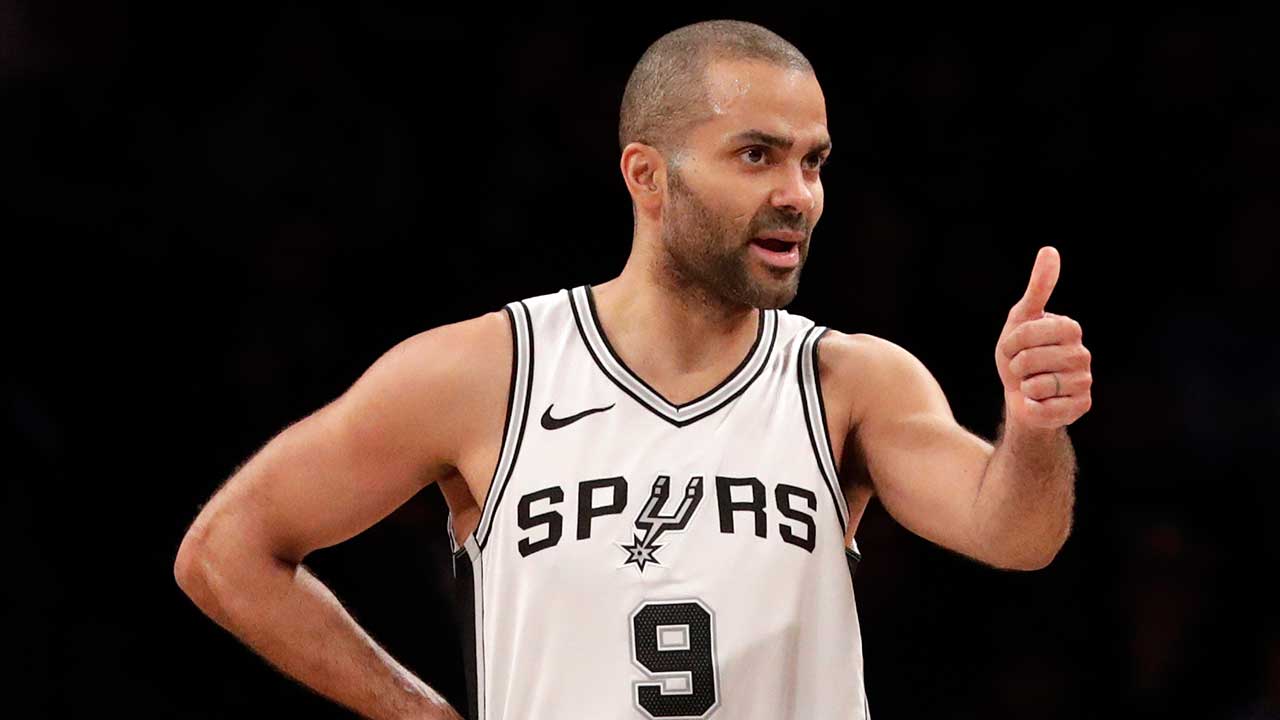
Tony Parker turned speed into a way of leading. He wasn't a point guard who needed to stop to orchestrate every offense. He received the ball, accelerated, and forced defenses to make decisions before they were ready. His first step, his rhythm changes, and that high layup he released before reaching the big men made him one of the NBA's best scorers in the paint, despite standing just 6'2".
He was never a great three-point shooter nor the most textbook floor general. His basketball was born from penetration, movement, and a special ability to find gaps where none seemed to exist. For seventeen seasons he was the point guard of the San Antonio Spurs and, alongside Tim Duncan and Manu Ginóbili, formed the core of one of the most stable dynasties in NBA history.
Born in Belgium and raised in France, Parker grew up in a family connected to basketball. His father, American, had played professionally in Europe. Tony attended INSEP, where he crossed paths with Boris Diaw, before beginning his career with Paris Basket Racing. Those formative years hardened a player who stood out for his quickness but still had to learn to control the game and withstand physical contact.
His professional debut came in the 1999/00 season. At just 17 years old, he averaged 3.9 points and 1.2 assists. His role was still limited, but a difficult-to-teach quality already appeared: Parker could change pace without losing control of the ball and reach the basket before the defense could close in.
The explosion came a year later. In 2000/01 he reached 14.7 points and 5.6 assists, was selected for the French All-Star team, and became one of the most attractive young players in European basketball. He was no longer just a quick point guard. He had begun to learn when to accelerate, how to use screens, and how to turn his speed into an advantage for his teammates.
San Antonio selected him with the 28th pick in the 2001 draft, though they came close to passing on him. In his first private workout, Parker was overpowered physically and Gregg Popovich left convinced he was too soft to lead a championship contender. R.C. Buford and a young Sam Presti insisted, prepared film to address the coach's concerns, and got the Frenchman a second chance. Parker responded much better and the Spurs changed their minds.
His first season confirmed that San Antonio had found something special. He averaged 9.2 points and 4.3 assists and became a starter from the fifth game. At 19 years old, he received the responsibility of leading a team that featured Tim Duncan and David Robinson and aspired to compete for the championship. He finished on the All-Rookie team, becoming the first point guard trained outside the United States to receive that distinction.
His relationship with Popovich was not easy. The coach constantly corrected him, demanded that he control the pace, and wouldn't accept his youth as an excuse. Tim Duncan would later recall that Parker was probably the player Popovich coached the hardest. The Frenchman endured the criticism, learned to live with it, and eventually earned the locker room's trust.
In the 2002/03 season he elevated his numbers to 15.5 points and 5.3 assists. San Antonio finished with 60 wins and reached the NBA Finals. Parker had important moments, like his 26 points in the third game against New Jersey, though in some Finals games Popovich preferred the experience of Speedy Claxton. He was still a developing point guard, but he closed his second year as an NBA champion.
The 2003/04 season produced 14.7 points and 5.5 assists. Parker continued increasing his control of the team, though San Antonio couldn't defend the title and was eliminated by the Los Angeles Lakers in the Western Conference semifinals. His speed was now known throughout the NBA, but he still alternated dominant performances with games where defenses managed to keep him away from the paint.
In 2004/05 he advanced to 16.6 points and 6.1 assists. San Antonio returned to the Finals and defeated the Detroit Pistons in a physical, tight series that required seven games. Parker didn't have his best offensive series, but he maintained control against the pressure of Chauncey Billups and added his second championship at just 23 years old.
The season ended with another important advance for French basketball. At EuroBasket 2005, Parker averaged 11.9 points and helped France win the bronze medal. After a painful loss to Greece in the semifinals, the French responded decisively by defeating Spain in the third-place game. It was Parker's first medal with the senior national team.
In the 2005/06 season he posted 18.9 points and 5.8 assists, shooting 54.8% from the field. His outside shot was still inconsistent, but he had become an extraordinary finisher near the rim. He used the glass, released the ball before contact, and punished big men with a floated layup that became known as his tear drop. That year he played in his first All-Star Game.
The 2006/07 campaign finished establishing him among the NBA's elite point guards. He averaged 18.6 points and 5.5 assists and returned to the All-Star Game. San Antonio eliminated Denver, Phoenix, and Utah before facing LeBron James and the Cleveland Cavaliers in the Finals.
Parker attacked Cleveland's paint over and over and was the Spurs' leading scorer in all four games. He averaged 24.5 points, shooting 56.8% from the field, and San Antonio won the series without conceding a single loss. At 25 years old, he became the first European player selected as MVP of an NBA Finals. It was his third ring and the definitive recognition of an evolution that had begun amid Popovich's doubts.
In the 2007/08 season he maintained his level with 18.8 points and 6 assists. The Spurs reached the Western Conference Finals again, though the Lakers prevented them from defending the title. Parker was no longer just the young point guard accompanying Duncan. He was one of the team's three major references and, on many nights, their primary offensive engine.
His best scoring season came in 2008/09. He averaged 22 points and 6.9 assists, made the All-Star team, and earned All-NBA Third Team honors. On November 5, 2008, he posted the highest scoring output of his career: 55 points, 10 assists, and 7 rebounds against Minnesota, in a game decided after two overtimes. That performance summarized his transformation. The point guard who had arrived in San Antonio without a reliable shot was now capable of completely taking over the offense.
The 2009/10 season was marked by various physical problems. His averages dropped to 16.5 points and 5.7 assists and Parker could only play in 56 games. San Antonio continued competing, but the accumulation of mileage and summers with the national team was beginning to take its toll.
In 2010/11 he regained continuity and produced 17.6 points and 6.6 assists. The Spurs won 61 games, though they were eliminated by Memphis in the first round, one of the big surprises of those playoffs.
That summer, Parker had one of his best tournaments with France. He averaged 22.1 points and 4.4 assists at EuroBasket 2011 and finished as the tournament's leading scorer. France reached the final after defeating Greece and Russia, but Spain again blocked the path to gold. The silver medal at least secured France's qualification for the London Olympics.
The NBA lockout delayed the start of the 2011/12 season and Parker took the opportunity to briefly play with ASVEL Villeurbanne, a club he had already begun to involve himself with off the court. In France he averaged 20.3 points, 6.3 assists, and 4.9 rebounds before returning to San Antonio when the dispute was resolved.
Back with the Spurs he posted 18.3 points and the best assist average of his career, with 7.7. He made the All-Star team, earned All-NBA Second Team honors, and finished fifth in MVP voting. San Antonio strung together twenty wins between the end of the regular season and the start of the playoffs, but Oklahoma City rallied to win the Western Conference Finals after losing the first two games.
The 2012/13 season was another of Parker's best. He averaged 20.3 points and 7.6 assists, made the All-Star team, and was again selected for the All-NBA Second Team. San Antonio reached the Finals against the Miami Heat and the Frenchman decided the first game with an impossible play: he kept the dribble alive while falling to the ground, regained his balance, and scored practically at the shot-clock buzzer.
The Spurs were seconds away from the championship in Game 6, but Ray Allen's three-pointer extended a series that Miami won in Game 7. It was one of the most painful losses of Parker's career, though just months later he found a reward he had been pursuing with France for years.
At EuroBasket 2013 he was the absolute leader of the national team. He averaged 19 points, finished as the tournament's leading scorer, and posted 32 in the semifinal against Spain, rallying from a game that seemed lost for much of the contest. France then defeated Lithuania and won the first European gold in its history. Parker was named tournament MVP.
The 2013/14 season began with San Antonio still marked by the loss to Miami. Popovich had the team review Game 6 of those Finals and the Spurs transformed the blow into a season of extraordinary collective basketball. Parker averaged 16.7 points and 5.7 assists, returned to the All-Star Game, and made the All-NBA Second Team for the third time.
San Antonio returned to the Finals and faced Miami again. This time they left no room for another disappointment. The Spurs won 4-1, moving the ball until they completely dismantled the rival defense. For Parker it was the fourth championship, seven years after the previous one and eleven after the first.
In 2014/15 he averaged 14.4 points and 4.9 assists. Physical problems were beginning to limit his availability, though he was still selected for the All-Star Game for the sixth time. San Antonio fell in the first round to the Los Angeles Clippers after a series decided in Game 7.
During the summer he played in EuroBasket, partially organized in France. Parker wasn't as sharp as in 2013 and finished with 12 points and 4.2 assists, but the national team rebounded after losing the semifinal to Spain and won bronze against Serbia. It was his fourth continental medal: one gold, one silver, and two bronzes.
In the 2015/16 season he dropped to 11.9 points and 5.3 assists. The emergence of Kawhi Leonard had shifted the team's offensive focus, while Parker began to manage his efforts. He remained a starter, though he no longer needed to attack every game with the aggression of his best years.
After that campaign he played in the Rio Olympics, his last competition with France. He thus closed an international career in which he had helped transform a competitive but titleless national team into a European champion and regular participant in decisive rounds.
In 2016/17 he contributed 10.1 points and 4.5 assists. San Antonio reached the Western Conference Finals, but Parker couldn't complete the playoffs. In the second game of the semifinals against Houston he suffered a torn left quadriceps tendon, a serious injury that ended his season and threatened the continuity of his career.
He returned during the 2017/18 season and averaged 7.7 points and 3.5 assists. After more than sixteen years as a starter, he accepted coming off the bench and ceding the position to Dejounte Murray. When the season ended, he decided to leave San Antonio, though his relationship with the franchise and with Popovich remained well above that farewell.
His final season was not with the Spurs but with the Charlotte Hornets. Parker sought a new context, wanted to share a locker room with Nicolas Batum, and reconnect with James Borrego, a former San Antonio assistant. In 2018/19 he averaged 9.5 points and 3.7 assists in 56 games, providing veteran minutes as a backup to Kemba Walker.
In June 2019 he announced his retirement. He was 37 years old and acknowledged that he no longer felt he could compete for a championship, the motivation that had guided his entire career. He departed after 1,254 games between regular season and playoffs and eighteen seasons in the NBA, seventeen of them with San Antonio.
His resume includes four NBA championships, one European gold, one silver, and two bronzes. He was the 2007 Finals MVP, a six-time All-Star, three times All-NBA Second Team, once All-NBA Third Team, and a member of the All-Rookie team.
But his influence transcends the awards. Parker proved that a European point guard could assume the direction of a championship contender from age 19, attack the paint with the same authority as great American scorers, and become a protagonist of a dynasty without losing his identity.
San Antonio retired his number 9 jersey and, in 2023, Parker was inducted into the Hall of Fame alongside Gregg Popovich. His name remained forever linked to those of Duncan and Ginóbili, the trio that accumulated 126 playoff wins and sustained the Spurs among the elite for more than a decade.
Tony Parker arrived in Texas as a quick young man whom Popovich considered too soft. He left with four rings, a Finals MVP, and recognition as one of the best point guards of his generation. He never stopped running, but he learned something even more difficult: when he should.


